Techathon Nationals & Rover Summit: 5th Place Among 26 Finalist Teams
July 11, 2026
Techathon Nationals & Rover Summit: 5th Place Among 26 Finalist Teams
On Friday, July 10, 2026, our team arrived at the Techathon Nationals & Rover Summit hosted at the Islamic University of Technology (IUT), Gazipur — a national flagship event organized by the IUT Robotics Society (IUTRS). Over 270 teams had registered, and only 26 advanced to the Hackathon Segment Final Round. We competed, built, and secured 5th position.
The event
Techathon Nationals & Rover Summit brought together engineering students, robotics enthusiasts, and innovators from across Bangladesh. The two-day event featured multiple tracks, including a robotics summit, exhibition booths, and the highly competitive hackathon segment — the one we were there for.
The atmosphere was electric. Teams from every corner of the country set up their workstations, some hauling full hardware setups, others — like us — running entirely in the browser. The panel of judges included academics and industry professionals, and the evaluation criteria were rigorous: technical depth, practical usability, presentation quality, and real-time demonstration.
What we built: Robo Arm Simulator
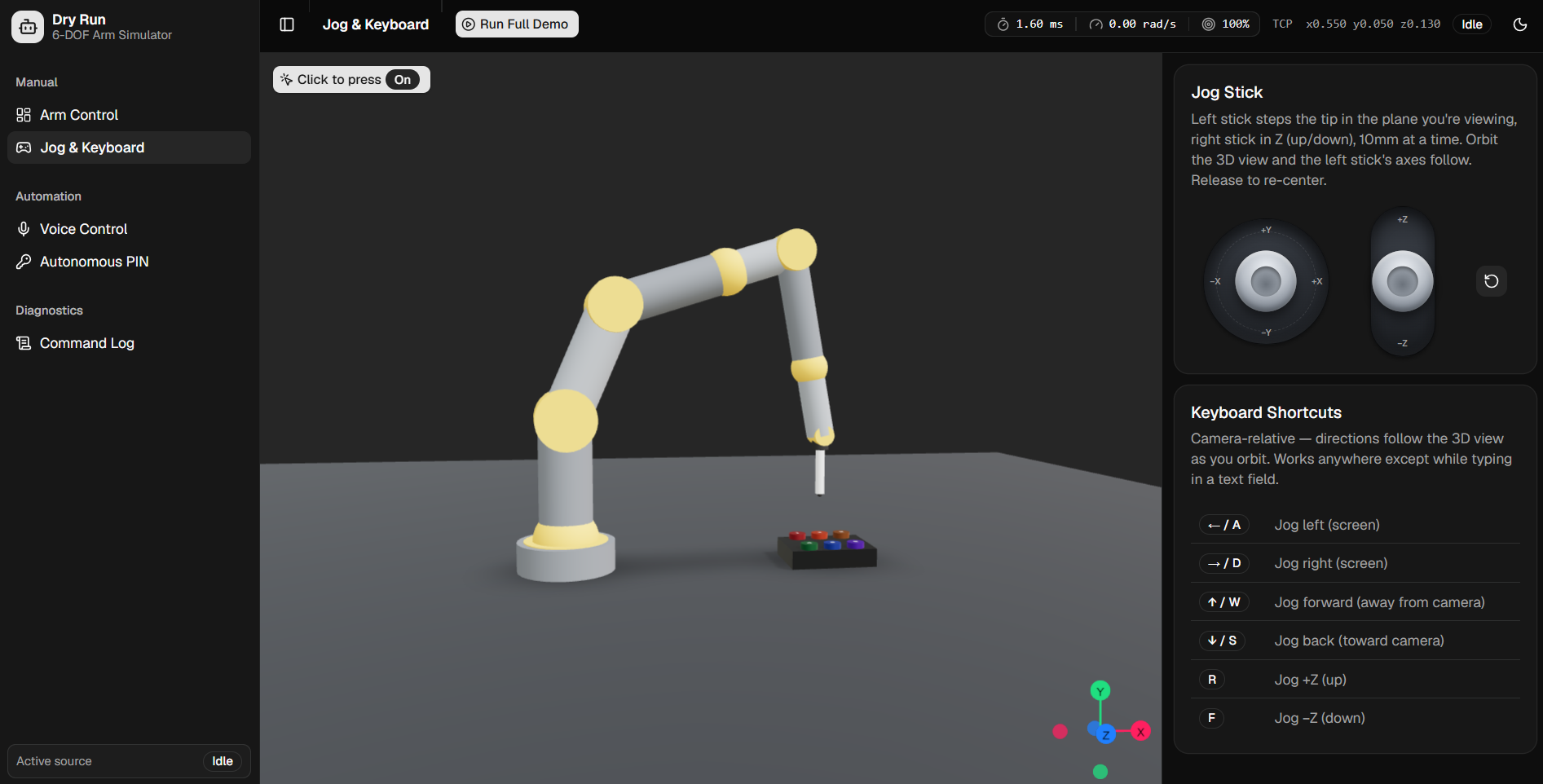
We built a browser-based 6-DOF robotic arm simulator and control suite — fully client-side, no hardware required for the simulator itself, but designed from day one to bridge to physical hardware through MQTT.
The core of the project is a centralized motion pipeline that every control surface routes through:
Key technical highlights
- 6-DOF 3D visualization rendered in real-time via React Three Fiber with URDF-loaded model, orbit controls, shadows, and HDRI lighting
- Closed-form inverse kinematics with a vertical-stylus constraint, approach-angle scanning, and seed-based selection preventing elbow snapping during continuous motion
- Forward kinematics verified against an independent implementation with a 5,000-sample random workspace sweep — all errors under 0.001mm
- Voice control with deterministic grammar mapping natural commands to motion, and an AI Agent mode powered by LLM-based multi-step planning
- MQTT live hardware bridge connecting to physical ESP32-driven arms with real-time telemetry, defence-in-depth safety, and standalone preview and controller pages
- Real-time collision detection — floor penetration and segment-vs-segment self-collision on non-adjacent link pairs
- Velocity-limited motion with smootherstep interpolation respecting per-joint URDF limits
Every command — from the dashboard sliders, jog pad, keyboard, voice, or AI agent — passes through a single dispatch() → resolveCommand() pipeline. This made the system provably safe and verifiable, which was a strong point during judging.
The competition
The final round was intense. 26 teams were given a fixed window to demo their projects, handle live questions, and show their systems under pressure. The judges paid close attention to:
- Originality — was this a novel approach or a repackaged tutorial?
- Technical depth — how deep did the engineering go? Did the team understand their own architecture?
- Demonstration quality — could the project run reliably in real time, in front of an audience?
Our demo went smoothly. We showed the arm moving through jog pad controls, triggered a voice command, ran a PIN entry sequence autonomously, and opened the MQTT panel to show live telemetry from the simulated hardware bridge. The judges appreciated the defence-in-depth safety architecture — that the browser, the central pipeline, and (if connected) the ESP32 firmware each independently enforce limits.
The result
When the results were announced, our team was called for 5th position among the 26 finalists. Out of 270+ teams that started this journey, we placed in the top five.
The moment was genuinely rewarding — not just for the placement, but because the project represented something we deeply believe in: that complex engineering can live entirely in the browser and still be production-grade, verifiable, and ready to connect to real hardware.
Lessons from the experience
- Ship a demo you trust. Because of the verification scripts (FK, collision, voice, agent, geometry sync, URDF safety), we knew the pipeline was correct before we walked in. That confidence showed during the demo.
- Architecture matters in judging. The centralized pipeline wasn't just good engineering — it was a clear story to tell the judges. "Everything goes through one function" landed better than any feature demo.
- A browser-based project can compete with hardware projects. We were one of the few teams running software-only, and the ability to show the full stack running on a single laptop without wiring or power supplies was a genuine advantage.
- Teams matter more than tech. My teammate @mdnaimur0 and I split the work cleanly — kinematics and pipeline on one side, 3D scene and controls on the other — and the integration held up because we talked through every interface before writing a line of code.
What's next
The Robo Arm Simulator is open source on GitHub. We're continuing to improve it, and the MQTT bridge means it already works with real ESP32-based arms. If you're into robotics, kinematics, or just want to play with a virtual robot arm, give it a try at the live demo.
Massive thanks to IUT Robotics Society for organizing this national-scale event, to the judges for their thorough evaluation, and to every team that competed — the level of engineering on display was genuinely inspiring.
See you at the next one.